
 RECOGNISED WORLD OVER SOLUTIONS
 INNOVATIVE FOR SIMPLIFICATION
 Find out how BSC GLOBAL digitally transformed P2P cycle for worlds renowned brand in Automobile







Audits play a critical role in helping organisations identify risks, improve business processes, strengthen internal controls, and maintain compliance. As businesses become increasingly dependent on digital systems such as SAP, traditional manual auditing methods are no longer enough to provide the speed, visibility, and accuracy that modern organisations require.
A well-designed audit process should go beyond identifying problems. It should help organisations understand risks, track findings, monitor controls, improve processes, and take corrective action.
This is why understanding the key features of an effective audit is essential for businesses looking to improve governance, risk management, compliance, and operational performance.
What Is an Audit?
SimpAudit
Leader in SAP compliance, securing 75% of the market. READ MORE
An audit is a structured examination of an organisation’s processes, systems, controls, transactions, or financial information to determine whether they meet defined requirements, policies, regulations, and business objectives.
Depending on the organisation’s requirements, audits can include:
- Internal audits
- Financial audits
- Operational audits
- Compliance audits
- IT audits
- SAP security audits
- IT General Controls (ITGC) audits
- Digitalisation audits
- Segregation of Duties (SoD) reviews
Modern audits increasingly combine business knowledge, data analysis, automation, and continuous monitoring to identify risks more efficiently.
Why Are Audit Features Important?
The effectiveness of an audit depends on more than simply performing checks. Organisations need a structured approach that allows auditors and management teams to move from risk identification to remediation and continuous improvement.
Important audit capabilities can help organisations:
- Identify security and compliance risks
- Detect unauthorised access
- Monitor internal controls
- Identify Segregation of Duties conflicts
- Improve audit planning
- Reduce manual audit effort
- Maintain audit evidence
- Track audit findings
- Monitor corrective actions
- Generate management reports
- Improve audit readiness
- Strengthen governance and accountability
For organisations operating complex ERP environments, these capabilities become particularly important because large volumes of users, roles, transactions, and business processes need to be monitored.
10 Key Features of an Effective Audit
1. Audit Planning and Scheduling
Effective auditing begins with proper planning.
An audit management process should allow organisations to define the audit scope, objectives, areas of review, responsible teams, timelines, and audit schedules.
Structured planning helps ensure that critical processes and high-risk areas receive appropriate attention.
For organisations conducting recurring audits, scheduling also helps create a consistent and repeatable audit process.
2. Risk Identification and Assessment
One of the most important features of modern auditing is the ability to identify and prioritise risks.
An effective audit should help organisations determine:
- What risks exist?
- Where are the risks located?
- Who or what is affected?
- How serious is each risk?
- What action is required?
Risk-based auditing allows organisations to focus resources on areas that could have the greatest business impact.
3. Internal Control Assessment
Internal controls are designed to reduce the likelihood of errors, fraud, unauthorised activities, and compliance failures.
An effective audit should evaluate whether controls are:
- Properly designed
- Implemented correctly
- Operating effectively
- Monitored regularly
- Supported by appropriate evidence
Control assessment is particularly important for organisations subject to regulatory or financial reporting requirements.
4. Segregation of Duties (SoD) Analysis
For organisations using SAP, Segregation of Duties (SoD) is a critical component of access governance.
SoD analysis helps identify conflicting combinations of access that could allow a user to perform incompatible activities.
For example, giving one user the ability to create a vendor and independently process payments could create a significant control risk.
Modern SAP audit solutions can automate SoD analysis, identify conflicts, assign risk levels, and provide visibility into user and role-level risks.
BSC Global’s SimpAudit is designed to automate SoD analysis, risk identification, user access reviews, and SAP security auditing.
5. User Access and Authorization Review
Access management is another important audit feature, particularly in ERP environments.
An effective audit should help organisations identify:
- Excessive user privileges
- Sensitive transactions
- Unauthorised access
- Privileged users
- High-risk roles
- Inactive or unnecessary access
- Emergency or firefighter access
Regular access reviews help organisations maintain stronger security and reduce the possibility of inappropriate access to sensitive business processes.
6. Audit Evidence and Documentation
Auditors need reliable evidence to support their findings.
Modern audit processes should provide a structured way to capture and maintain:
- Supporting documents
- System data
- Control evidence
- Audit observations
- Test results
- Findings
- Management responses
- Corrective actions
Centralised audit evidence can make audits easier to review and reduce the time spent searching across spreadsheets, emails, and disconnected systems.
7. Audit Findings and Corrective Action Tracking
Identifying a problem is only the first step.
An effective audit should also provide a mechanism for recording findings, assigning responsibility, establishing deadlines, and monitoring corrective actions.
A strong findings-management process should answer:
What was identified? Who owns it? What needs to be done? When is it due? Has it been resolved?
This creates accountability and helps organisations ensure that audit findings do not remain unresolved.
8. Automated Audit Checks
Manual auditing can require significant time and effort, particularly when auditors need to analyse large volumes of ERP data.
Audit automation can help organisations perform repetitive checks more consistently and efficiently.
Automated audit checks can be used to identify:
- Access risks
- SoD conflicts
- Sensitive transactions
- Configuration issues
- Compliance gaps
- Financial control risks
- Master data issues
BSC Global’s SimpAudit provides automated SAP security, SoD, compliance, and risk checks designed to reduce dependence on manual audit processes.
9. Audit Reporting and Dashboards
Audit results need to be communicated clearly to management, auditors, compliance teams, and other stakeholders.
Effective audit reporting should provide visibility into:
- Open risks
- Critical findings
- Control deficiencies
- SoD violations
- User access risks
- Corrective actions
- Audit status
- Compliance performance
Dashboards can make large volumes of audit information easier to understand and allow management to focus on the highest-priority risks.
10. Continuous Monitoring
Traditional audits often provide a point-in-time view of an organisation’s controls and risks.
However, business systems change continuously.
Users receive new access. Roles change. Transactions occur. Configurations are modified. New risks can emerge between audit cycles.
Continuous monitoring helps organisations move from a purely periodic approach toward a more proactive risk-management model.
For SAP environments, continuous monitoring can help identify new access risks and compliance issues as they emerge.
Audit Management Software vs Manual Auditing
Many organisations still rely heavily on spreadsheets, emails, and manual data extraction to manage audits.
While these methods may work for smaller audits, they can become difficult to manage as the organisation and SAP landscape grow.
| Capability | Manual Auditing | Modern Audit Management |
|---|---|---|
| Audit planning | Manual | Structured |
| Risk identification | Periodic | Automated/continuous |
| Access review | Manual analysis | Automated analysis |
| SoD checking | Time-consuming | Automated |
| Evidence management | Multiple files | Centralised |
| Findings tracking | Spreadsheets | Structured workflow |
| Corrective actions | Manual follow-up | Automated tracking |
| Reporting | Manual preparation | Dashboards and reports |
| Monitoring | Periodic | Continuous |
| Audit readiness | Reactive | Proactive |
The objective is not necessarily to eliminate human auditors. Instead, technology can automate repetitive activities so auditors can spend more time on analysis, judgement, and risk remediation.
Key Features of SAP Auditing
For organisations running SAP ECC, SAP S/4HANA, or RISE with SAP, audit requirements can become particularly complex.
A comprehensive SAP audit may include:
- SAP user access analysis
- SAP role analysis
- Segregation of Duties analysis
- Sensitive transaction monitoring
- Privileged access monitoring
- Firefighter or emergency access review
- ITGC controls
- Financial risk and compliance checks
- Audit evidence collection
- Compliance reporting
- Continuous control monitoring
BSC Global’s SAP auditing services cover areas including SAP security, business processes, financial audits, operational audits, and digitalisation audits.
How SimpAudit Supports Modern SAP Auditing
SimpAudit by BSC Global is an SAP security audit solution designed to help organisations identify and manage risks across their SAP environments.
Its capabilities include SoD analysis, risk scoring, user and role-level visibility, critical access monitoring, firefighter tracking, audit-ready reporting, and automated compliance checks.
The platform is designed to provide organisations with greater visibility into SAP security and compliance risks while reducing reliance on manual audit processes.
For example, BSC Global’s work with Cummins India highlights the use of SimpAudit for automated audit checks, SAP authorization analysis, risk and compliance monitoring, reporting, and continuous monitoring.
What Should Organisations Look for in Audit Management Software?
When evaluating an audit management or SAP audit solution, organisations should consider more than the number of features.
Important evaluation criteria include:
- Ease of implementation – Can the solution be deployed without excessive complexity?
- Automation – Can repetitive audit checks be automated?
- Risk visibility – Can teams quickly identify critical risks?
- Scalability – Can the solution support growing SAP environments?
- Reporting – Can audit-ready reports be generated efficiently?
- Integration – Can the solution work effectively with existing SAP environments?
- Continuous monitoring – Can risks be monitored between audit cycles?
- Remediation support – Can findings and corrective actions be tracked?
- User and role analysis – Can access risks be identified at user and role level?
- Compliance support – Can the solution support internal audit, SOX, ITGC, and other compliance requirements?
The Future of Auditing: From Periodic Reviews to Continuous Assurance
The future of auditing is moving toward greater automation, data-driven analysis, and continuous monitoring.
Instead of waiting for the next audit cycle to discover a risk, organisations can use technology to monitor important controls and access continuously.
This approach can help businesses identify risks earlier, improve audit readiness, and provide management with a more current view of their control environment.
For SAP-centric organisations, automated security and compliance monitoring can become an important component of a broader governance, risk, and compliance strategy.
Conclusion
The most effective audits combine structured planning, risk assessment, control evaluation, evidence management, automated testing, findings management, reporting, and continuous monitoring.
As organisations become more dependent on SAP and other enterprise technologies, manual audit processes can struggle to keep pace with changing users, roles, transactions, and compliance requirements.
Modern audit management solutions can help organisations move from manual, periodic auditing to automated, risk-focused, and continuous audit management.
For organisations looking to strengthen SAP security, compliance, and audit readiness, solutions such as SimpAudit by BSC Global can provide automated visibility into access risks, Segregation of Duties, compliance gaps, and other critical areas of the SAP environment.
Key Use Cases
SOX Compliance Automation
Audit , Secure and Correct.
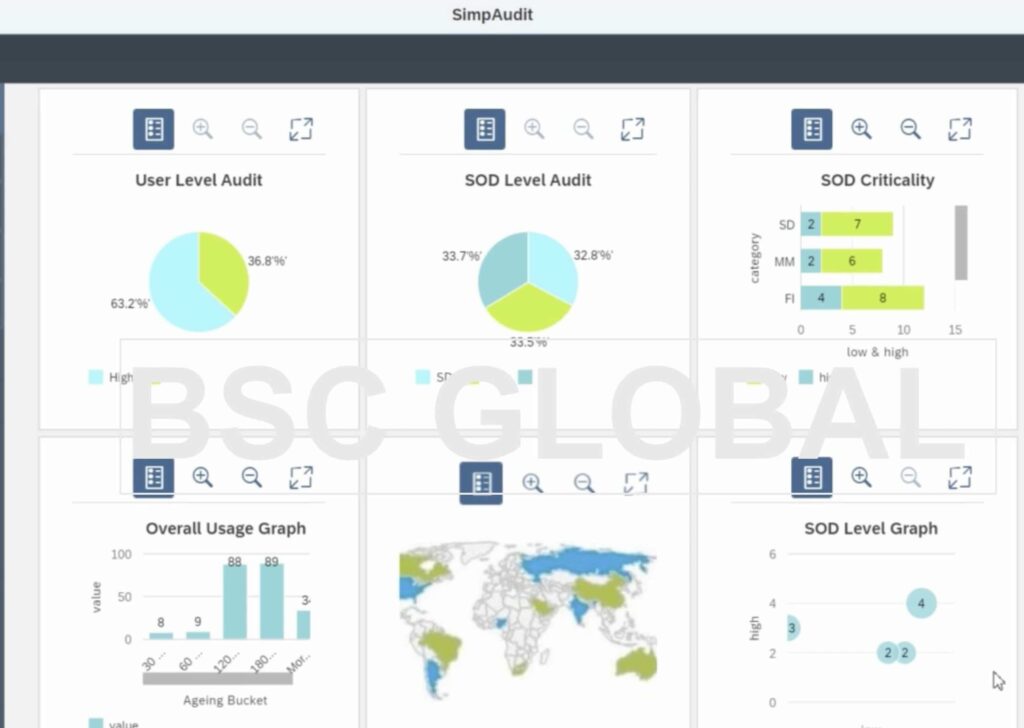
Eliminate manual data processing of major Financial KPI’s
- ✓ Comprehensive Visibility: SoD violations, ITGC gaps, SU01 changes, and user-level risk analysis.
- ✓ Drill-Down Insights: Click into risks to see impacted users, roles, and transactions.
- ✓ Real-Time Alerts & Heatmaps: Dynamic charts highlight high-risk zones for faster audits.
User Access Review Simplification
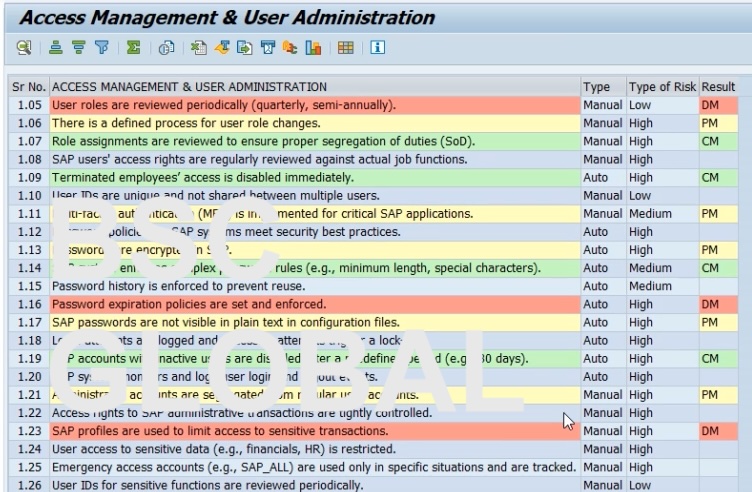
Within SAP, No Batch and No Synchronisation.
natively embedded within SAP
- ✓ Zero Data Export & Real-Time Access: Operates directly on SAP tables and authorization objects.
- ✓ Secure & Efficient Analysis: Fast, accurate risk insights with minimal performance impact.
- ✓ Fully SAP-Aligned: No third-party connectors; more reliable than external audit tools.
ITGC Monitoring
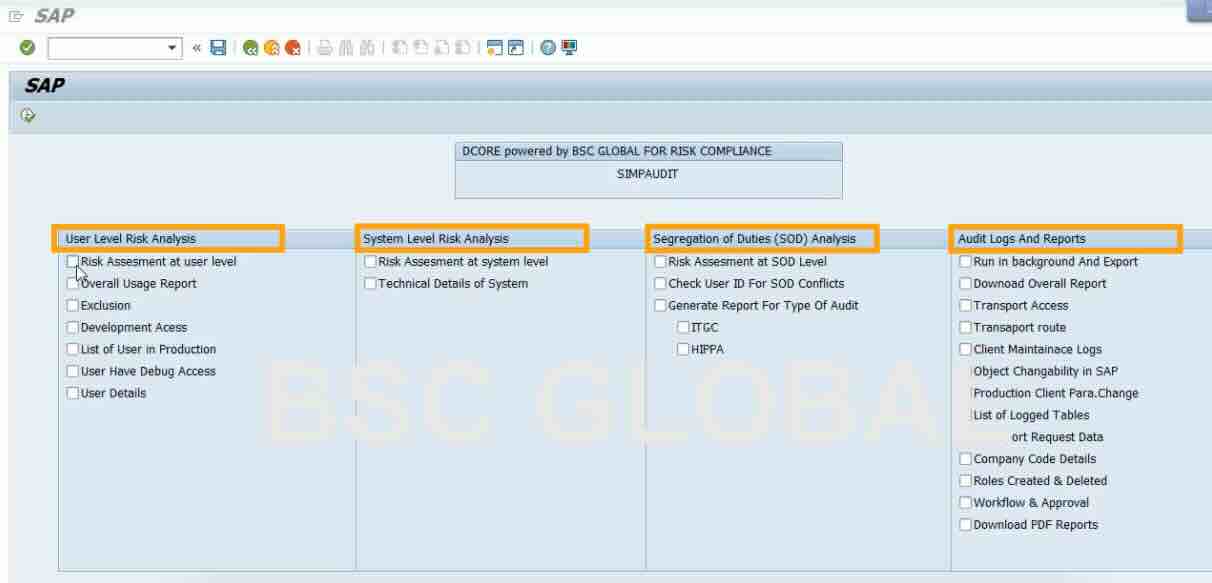
SoD tool for precise, real-time SAP risk management and compliance.
2000 Plus Risk Library
- ✓ Comprehensive SoD Analysis: Detects violations across SAP with precision.
- ✓ Custom Rules & Automated Scoring: Tailored policies with prioritized risk focus.
- ✓ 2,000+ Predefined Risks: Ready-to-use risk library.
Notifications and Alerts
Real time update for any alerts and risks.
Get notified in email and sms
- ✓ Real-Time Alerts & Notifications: Instantly notifies teams with custom triggers for transactions, users, or role changes.
- ✓ Email & SAP Inbox Integration: Deliver alerts directly to user inboxes inside or outside SAP.
- ✓ Heatmaps & Audit Trails: Visual summaries highlight risks and log every alert for compliance.
SAP Authorisation Role Auto Correction
We ensure that we leave you with Safe System.
Safe System is our goal
- ✓ Fix SoD Violations: Detects risks and provides corrective actions.
- ✓ Automated Role Clean-Up: Implements remediation directly in SAP.
- ✓ Real-Time Enforcement: Flags violations and optimizes roles instantly.