
 RECOGNISED WORLD OVER SOLUTIONS
 INNOVATIVE FOR SIMPLIFICATION
 Find out how BSC GLOBAL digitally transformed P2P cycle for worlds renowned brand in Automobile







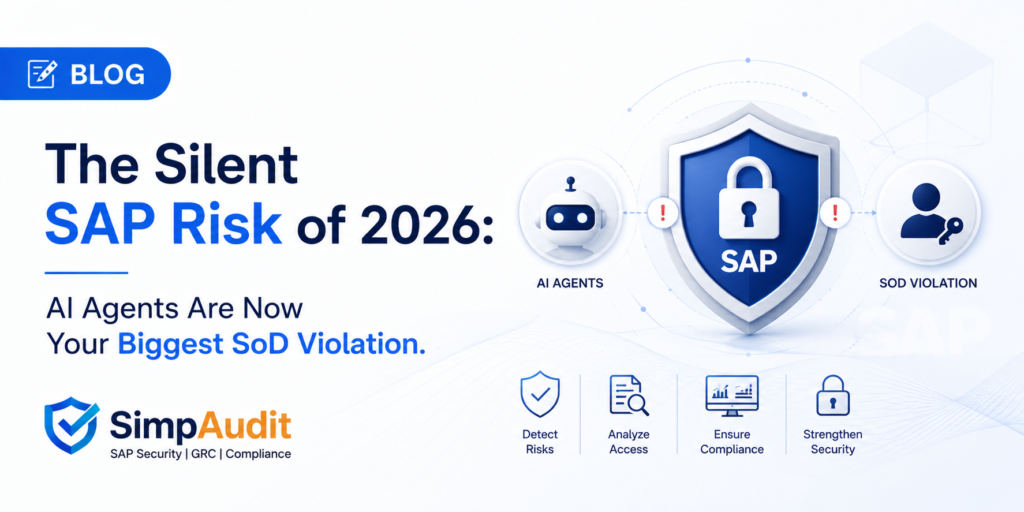
The Silent SAP Risk of 2026: AI Agents Are Now Your Biggest SoD Violation
Your Newest SAP User Doesn’t Sleep, Doesn’t Forget, and Might Not Have an Owner
Every SAP-connected AI agent that can post a journal entry, change a vendor master record, or approve a purchase order is a new non-human identity with real, executable authority. In many SAP landscapes today, these non-human identities already outnumber human users — and they’re accumulating access faster than anyone is reviewing it.
This isn’t a future risk. It’s already the structural reality of 2026 SAP environments.
Why Traditional SoD Frameworks Weren’t Built for This
Agentic AI accounts are non-human, often short-lived, and frequently created outside standard IAM onboarding processes — which makes them easy to over-privilege and hard to audit using controls designed for people. When one of these accounts is compromised, misconfigured, or repurposed, it can execute conflicting or fraudulent actions at machine speed, with none of the human friction that normally slows down a bad decision.
Line-of-business teams plugging copilots and workflow bots into SAP often reuse generic service accounts or hard-coded tokens, stacking automations without the joiner-mover-leaver discipline applied to human employees. The result: powerful, poorly governed identities hiding in plain sight.
The Same SoD Question, at Machine Speed
The core question hasn’t changed — can any single identity create a vendor and then pay that vendor? Approve its own transaction? Bypass a control designed to require a second set of eyes? What’s changed is that the identity asking these questions might be an AI agent instead of a person, and it can execute the conflict in milliseconds instead of days.
What Governing AI Identities in SAP Actually Requires
- A unified inventory of every human and non-human identity with SAP access — no exceptions for “just a bot”
- Formal ownership and a documented approval path for every AI agent identity, the same as any privileged human role
- SoD rules extended to cover agent-to-agent and agent-to-human toxic combinations, not just human-to-human
- Real-time monitoring and revocation paths — because a short-lived agent identity that outlives its purpose is a live risk, not a filed-away one
SimpAudit Was Built for This Shift
SimpAudit’s SoD analysis engine doesn’t distinguish between a human user and a service account when it comes to risk — every identity with SAP access gets scored, monitored, and flagged the same way. As AI agents become standard SAP users, that consistency is exactly what audit and compliance teams need.
Book a free demo and see how SimpAudit maps AI and non-human identity risk inside your SAP landscape — before it becomes the finding in your next audit report.
Click Here to Learn more: